
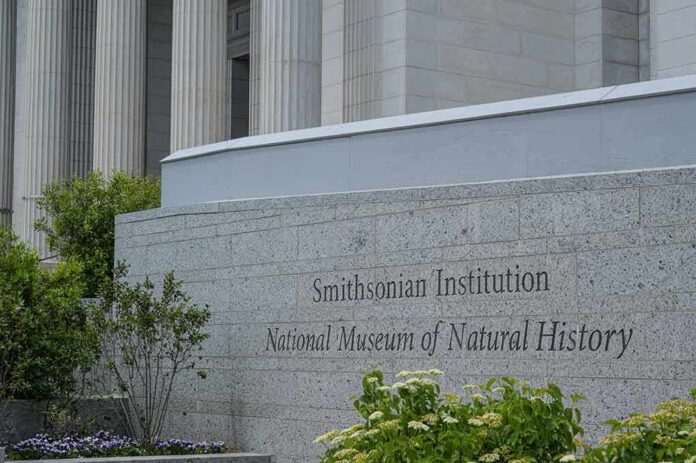
The central issue is not simply whether one museum exhibit is controversial; it is whether political power can be used to reorder public history until museums serve ideology instead of evidence. Ayanna Pressley has cast the Trump-aligned campaign around the Smithsonian in precisely those terms, and the available record shows that the fight is really about control of memory, institutional autonomy, and who gets to define what counts as “American” history.
Key Points
- Pressley’s argument is that attacks on Smithsonian museums are part of a broader authoritarian pattern aimed at censoring history and narrowing public thought.
- The Trump administration has sought formal review and revision of Smithsonian exhibitions and materials, using language about “divisive” or “anti-American” content.
- The dispute is larger than the Smithsonian itself, because major cultural institutions often become the battleground where governments test how far they can shape public memory.
- Pressley and allied lawmakers have responded not just with speeches, but with letters, hearings, and demands for oversight of the Smithsonian’s independence.
Why Museums Become Political Targets
Museums are attractive targets for would-be culture arbiters because they do something governments cannot fully control: they organize facts into durable public narratives. A speech can be ignored; a museum label, gallery, or permanent collection reaches students, tourists, donors, teachers, and future curators for years. That is why museum politics is rarely only about art or artifacts. It is about authority over the story a nation tells itself, and over whether difficult history remains visible once a political coalition decides it is inconvenient.
That is the frame Pressley used when she asked why neo-fascist autocrats attack museums. In her telling, the answer is simple: they understand that cultural institutions shape what people believe is normal, patriotic, shameful, or true. Pressley said Trump was working “overtime to turn our museums into instruments of maga propaganda” and described the effort as hostility toward “history, academia, museums, and the arts.” Her House floor remarks and follow-up statements place the Smithsonian fight inside a long tradition of illiberal politics: pressure the institutions that preserve memory, and you pressure the public mind as well.
What the Smithsonian Fight Is Actually About
The immediate dispute concerns Trump’s executive action and related directives aimed at Smithsonian museums, including review of exhibitions, narratives, and other materials deemed “divisive” or “race-centered.” Reporting and official statements describe a process in which the administration sought to scrutinize displays, wall text, and future programming, while framing the Smithsonian as drifting toward “extreme political activism” rather than neutral scholarship. The White House’s own language makes the underlying intention explicit: to align Smithsonian content with a preferred national story centered on “American exceptionalism” and the removal of what it calls partisan narratives.
Pressley and allied Democrats view that as an attempt to censor rather than improve public history. In May 2025, Pressley and Rep. Paul Tonko led 69 colleagues in a letter to the Smithsonian inspector general requesting an investigation into the executive order’s impact on museums including the National Museum of African American History and Culture, the American Art Museum, and the American Women’s History Museum. Their charge is not merely that the administration disapproves of certain exhibits, but that it is using federal leverage to pressure a congressionally chartered institution into revising scholarship for political ends.
How Pressley Frames the Threat
Pressley’s rhetoric is unusually sharp because she is not describing a standard dispute over curatorial judgment. She is describing an authoritarian method. In a House speech on April 11, 2025, she said Trump’s move toward Smithsonian museums was an attempt to erase Black history and insisted that “Dictators try to shutter museums, censor history, and white wash the truth.” In later statements, she called the effort a “brazen attempt to whitewash history” and said the Smithsonian’s duty is to provide “a full, accurate, and resonant telling of American history.” That language matters because it identifies the real stakes as epistemic: not just what the Smithsonian displays, but what kind of truth a public institution is allowed to maintain.
Her position is also consistent with her broader record. She has repeatedly tied attacks on museums to attacks on Black history and other marginalized narratives, describing these moves as part of a larger campaign that also includes rollbacks of DEI programs and book bans. Human Rights Watch likewise noted her resolution to protect Black history museums and cultural institutions, underscoring that this is not a one-off flourish but part of a sustained legislative and rhetorical pattern. Pressley’s approach is therefore best understood as institutional defense, not symbolic outrage.
The Administration’s Counter-Claim: Neutrality or Revisionism?
The administration and its allies do not present their actions as censorship. They present them as correction. The White House has described its effort as a way to restore confidence in cultural institutions, remove divisive narratives, and ensure museums do not become platforms for ideological indoctrination. Republican committee messaging has gone further, accusing the Smithsonian of promoting a narrow and politically tendentious agenda rather than celebrating the nation’s history. In other words, both sides claim to be defending truth; they disagree radically about which truths are being suppressed.
This is the core tension in contemporary museum politics. One camp treats the inclusion of slavery, racism, gender exclusion, and colonial violence as essential historical accounting. The other treats the same material, when foregrounded, as a distortion of national identity. Sector observers have warned that political pressure of this kind can create a chilling effect well beyond one institution, because what happens to the Smithsonian often becomes a template for the rest of the museum field. That warning is plausible precisely because the Smithsonian occupies a singular position in American public life: it is both symbolic and federally entangled.
Why the Smithsonian Matters More Than a Single Museum
The Smithsonian is not just another cultural nonprofit. It is a national system with enormous reach, public visibility, and a special relationship to federal power. That makes it especially vulnerable to political capture and especially important as a precedent. When a president, Congress, or White House-aligned report starts dictating what may or may not appear in museums, the issue is no longer routine oversight. It is an assertion that public history must be filtered through official ideology before it can reach the public.
That is why scholars and museum organizations have reacted so strongly. The Museums Association reported concern that demands to eliminate “divisive” or “anti-American” content could chill curatorial independence across the field. Other coverage has noted that the administration’s review encompassed current and forthcoming exhibitions and even internal communications, a scope broad enough to affect not just what is shown now, but what institutions think they are permitted to plan for the future. Once that precedent is normalized, the effect extends far beyond Washington.
What Pressley’s Question Exposed
When Pressley asked why fascists and autocrats attack cultural institutions, she was pressing for the mechanism, not the slogan. The answer offered in the hearing was blunt: such regimes seek control over minds, education, the arts, writing, and creativity itself. That explanation tracks with political history. Museums are powerful because they sit at the intersection of expertise and legitimacy. They can legitimize uncomfortable facts, and that is exactly what makes them vulnerable when a governing coalition wants simpler myths.
The deeper significance of the exchange is that it stripped away the usual euphemisms. This was not framed as a debate over exhibit design or funding efficiency. It was framed as a struggle over whether public institutions will preserve inconvenient history or be disciplined into flattering the state. Pressley’s response makes sense within that frame, and the documentary record supports it: the administration did seek review and alignment, lawmakers did seek an investigation, and museum-sector observers did warn about a broader chilling effect. That combination is what gives the episode lasting importance.
Sources:
twitchy.com, pressley.house.gov, youtube.com, mediaite.com, smithsonianmag.com, si.edu, en.wikipedia.org, museumsassociation.org, humanrightsresearch.org, washingtonpost.com, pbs.org