

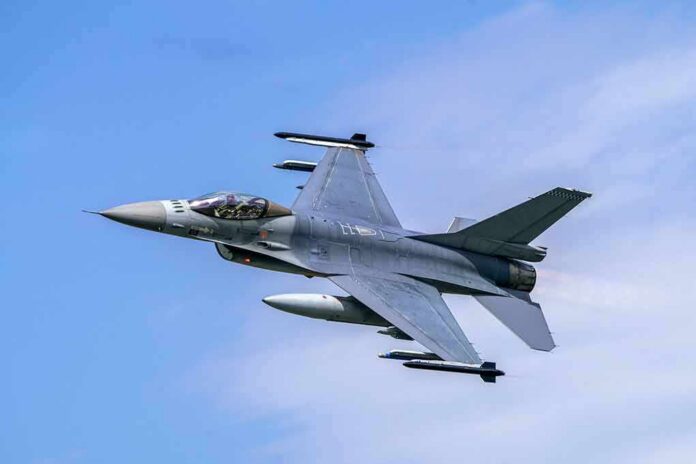
The important truth about the F-15EX isn’t whether the magic number is 12, 22, or even 28 missiles, but that “what it can carry” splits cleanly into two categories: what the jet is actually certified and funded to fly today, and what Boeing’s engineering and marketing say it could carry if future racks and stations are bought and tested.
At a Glance
- Operationally validated F-15EX air‑to‑air loadout today is 12 missiles; that’s what the U.S. Air Force has tested, certified, and plans to field.
- The widely quoted 22‑missile figure is a proposed, not yet funded or tested, configuration that depends on the AMBER rack system and fully weaponized conformal fuel tank stations.
- Boeing and derivative outlets blur the line between potential and operational capability, a familiar pattern across modern fighter programs.
- The missile count keeps “moving” because each step—from brochure to prototype to combat‑ready fleet—requires separate engineering, testing, certification, and budget decisions.
Where the Numbers Come From: 12 Versus 22
If you strip away the hype, the numbers attached to the F-15EX are straightforward once you sort them by status. The only missile load the U.S. Air Force has publicly demonstrated, evaluated, and declared ready for operational use is a 12‑missile air‑to‑air configuration. This figure appears consistently in formal testing reports, service statements, and mainstream technical write‑ups: twelve AIM‑120 AMRAAM or AIM‑9X Sidewinder missiles, carried externally on underwing and fuselage stations. In late 2022, test jets at Eglin Air Force Base flew with that configuration, fired from new outboard stations, and completed the validation needed for combat certification.
The larger 22‑missile number arises from Boeing’s concept of the “Advanced Eagle” as a missile truck. Marketing materials, derivative articles, and several enthusiast videos describe the jet as capable of hauling 22 air‑to‑air weapons by combining high‑capacity racks with extra fuselage stations. Wikipedia’s technical summary, based on Boeing data, explains the mechanism: a proposed AMBER (Advanced Missile and Bomb Ejector Rack) system and fully exploited conformal fuel tank weapon stations would allow up to sixteen AIM‑120s, four AIM‑9s, and two AGM‑88 HARMs in one extreme loadout. In other words, the “22” is not imaginary—but it is explicitly framed in those sources as potential, not as a configuration that has been tested, funded, or cleared for squadron use.
How the F-15EX Actually Carries Missiles
To understand why the official answer is 12 and the theoretical answer can reach 22 or more, you have to look at stations and racks, not just raw payload in pounds. The F‑15EX inherits the Strike Eagle’s rugged airframe and adds digital flight controls, conformal fuel tanks (CFTs), and more hardpoints—12 external stations plus two conformal weapon stations built into the fuselage. Each station can host either a single launcher or a multi‑pack rack, and the racks themselves can be upgraded over time. Traditional F‑15s top out at eight air‑to‑air missiles because their pylons are limited to single or dual launchers; the EX’s new outboard underwing stations add four more missiles for a total of 12 when loaded with AIM‑120s or AIM‑9Xs.
AMBER is where the math changes. A modern ejector rack such as AMBER is designed to carry and release multiple missiles from one station—in effect, stacking weapons vertically while maintaining safe separation at launch. Concept art and engineering discussions describe quad‑pack AMRAAM racks on inner wing and belly stations, with additional missiles mounted along the CFT stations. Combine that with all 12 traditional hardpoints and the two conformal stations, and the count can climb into the low twenties for relatively light weapons like AIM‑120s. The airframe and engines can support the weight; the limiting factors are aerodynamics, safe separation, and whether the Air Force chooses to buy, test, and certify such racks for operational use.
Marketing Potential vs. Operational Capability
The reason the story feels slippery is that aircraft manufacturers routinely advertise maximum theoretical loadouts, while services are obligated to talk only about what has been physically flown through a test envelope and documented. Boeing’s own description of the F‑15EX highlights “the unique ability to accommodate up to 12 AMRAAMs or an equivalent mix of large ordnance,” then points to expanded missile capacity with future racks as part of the platform’s growth path. Independent write‑ups follow suit: technical guides and enthusiast sites repeat the 22‑missile claim but, when you read carefully, nearly all specify that those numbers depend on “proposed” or “potential” configurations, using language such as “can potentially carry” and “has not been tested or funded.”
This distinction between brochure payload and certified capability is not unique to the F‑15EX. It mirrors earlier controversies around the F‑35, F/A‑18E/F, and F‑22, where early marketing touted higher missile counts using external pylons and future racks that only partially materialized. In each case, the limiting factor was not the basic physics of hanging more weapons under the wings, but the engineering, flight testing, and budget required to prove those configurations safe at combat speeds and G‑loads. Airworthiness rules and weight‑and‑balance constraints mean every new rack or station combination becomes a separate project, often spanning years. Those layers are invisible in a brochure headline—but they completely control what squadrons can actually fly.
What Has Been Demonstrated So Far
The F‑15EX has moved beyond the brochure in some areas. Eglin’s tests in late 2022 and early 2023 demonstrated live firings from new underwing missile stations, expanding the jet’s air‑to‑air capacity to twelve and validating separation and structural loads for that configuration. Air Force Technology and other defense outlets reported that two F‑15EX aircraft carried and fired the full 12‑missile load during those trials, a step the service described as a “major” milestone toward operational fielding. That is why official descriptions from Air Combat Command and program test reports talk about a “full complement of 12 air‑to‑air weapons” and note specifically that the EX has two more stations than the F‑15E.
The same test campaign also explored heavy standoff munitions—three AGM‑158 JASSM cruise missiles on a single jet, as well as mixed loads of air‑to‑air and precision‑strike weapons. Those flights reinforce the broader point: in the real world, the F‑15EX will often trade raw missile count for range, fuel, and large standoff weapons. An extreme 22‑missile “magazine” loadout is valuable as a design proof‑of‑concept, but the test program so far has focused on combinations that map to likely missions: escort, defensive counter‑air, and stand‑off strike in support of stealth aircraft.
Why “22 Missiles” Is Still Only a Goal
So why hasn’t the Air Force simply bought the racks and flown the full 22‑missile configuration if the design supports it? The available reporting points to three practical reasons. First, AMBER and similar high‑capacity racks are still treated as proposed hardware for the F‑15EX, not baseline equipment; Boeing and secondary sources emphasize them as future options rather than current inventory. Second, no public test documentation, imagery, or program report shows an F‑15EX actually carrying 22 air‑to‑air missiles in flight—every confirmed test configuration tops out at 12. Independent compendiums that track missile capacity likewise describe 22 as a design target that has “not been confirmed as fully tested or operationally fielded.”
Third, integration priorities follow mission needs and funding, not maximum theoretical count. The Department of Defense’s test office notes that the EX has two extra weapons stations relative to the F‑15E and is being integrated with a “complement of air‑to‑air weapons” and multiple large standoff munitions. Budget proposals simultaneously expand the planned F‑15EX fleet—up to 267 aircraft—but say nothing about acquiring exotic racks to push missile count into the twenties. In a constrained budget environment, it is entirely rational to first certify the 12‑missile configuration, which already exceeds the air‑to‑air load of stealth fighters, and to add heavy stand‑off weapons that change the operational picture more than marginal extra AMRAAMs.
How to Read Future Claims About F-15EX Loadouts
For a reader trying to make sense of competing numbers, a simple rule of thumb helps. When the source is Boeing marketing, derivative web features, or enthusiast YouTube channels, “up to 22 missiles” almost always means the design can, in principle, support that many weapons with advanced racks and fully utilized CFT stations—but it does not mean the Air Force has flown or fielded that load. When the source is a test wing, a formal DOT&E report, or a mainstream defense outlet quoting program officials, “12 missiles” refers to a specific, documented configuration that has passed separation and loads testing and is cleared for operational units.
In practice, the F‑15EX is already a “missile truck” in any reasonable sense of the term—a non‑stealthy fighter built to orbit at range, carrying more air‑to‑air and standoff weapons than the stealth jets it supports. Whether squadrons ever fly 22‑missile AMBER loadouts will depend on future funding, test priorities, and evolving air combat doctrine. The important distinction is not between 12 and 22 as absolute limits, but between what has been demonstrated and certified versus what remains a credible, but still aspirational, design capability.
Sources:
19fortyfive.com, en.wikipedia.org, defensenews.com, missiledefenseadvocacy.org, speedoscience.com, airforce-technology.com, ms.wikipedia.org, ru.wikipedia.org, zh.wikipedia.org, tw.news.yahoo.com, youtube.com, acc.af.mil, ntrs.nasa.gov, thecipherbrief.com